
Tree Trimming Wichita, KS
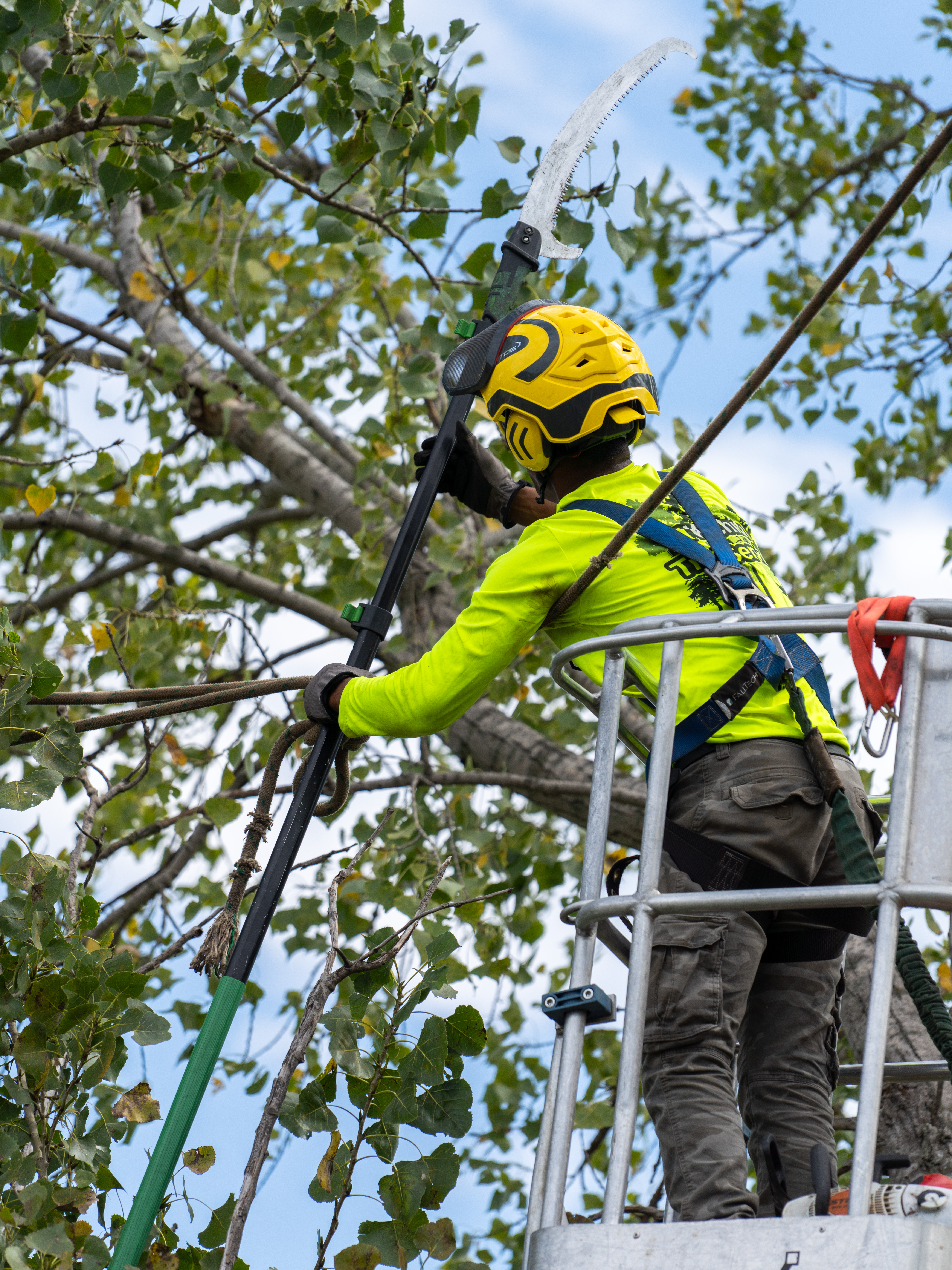
Is Tree Trimming Good for Trees?
Tree trimming sounds harmless. Most people assume that if a tree is trimmed, it must be good for the tree. Unfortunately, that is not always true.
Every pruning cut creates a wound, changes the tree, and affects how it will grow in the future. Good pruning can reduce risk, improve structure, and solve problems. Bad pruning can weaken a tree, create decay, increase storm damage, and shorten its lifespan.
Before you hire someone for tree trimming in Wichita, take a minute to understand what proper pruning actually means. Robert Phillips, Board Certified Master Arborist and owner of Wichita Tree Service, explains how arborists think about pruning, when it helps, and when bad pruning can do more harm than good.
Before you hire someone for tree trimming in Wichita, take a minute to understand what proper pruning actually means. Robert Phillips, Board Certified Master Arborist and owner of Wichita Tree Service, explains how arborists think about pruning, when it helps, and when bad pruning can do more harm than good.
What is Tree Pruning?
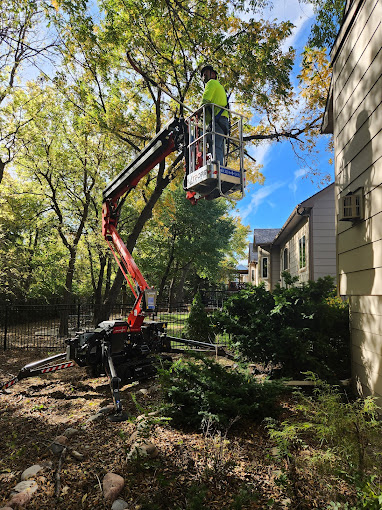
When I took the Kansas arborist exam, one question stood out: "What is pruning?" The answer they were looking for might surprise a lot of homeowners:
pruning is the intentional wounding of a tree. That answer is meant to be a wake-up call. Pruning is not just cutting branches to make a tree look cleaner. Every cut creates a wound, and every cut changes the tree forever.
The International Society of Arboriculture (ISA) takes a more straightforward approach. In simple terms, pruning is the removal of parts of a plant, such as branches, shoots, and leaves.
Both definitions are correct. The ISA definition explains what pruning is. The Kansas arborist definition reminds us why pruning should be taken seriously. Every pruning cut removes part of the tree, creates a wound, and affects how the tree will grow in the future.
That is why professional arborists do not simply ask, "What can we cut?" The better question is, "What are we trying to accomplish?"
Why Bad Tree Trimming Can Cost More Than Proper Pruning.
Hiring the wrong company can cost more than hiring a qualified arborist in the first place.
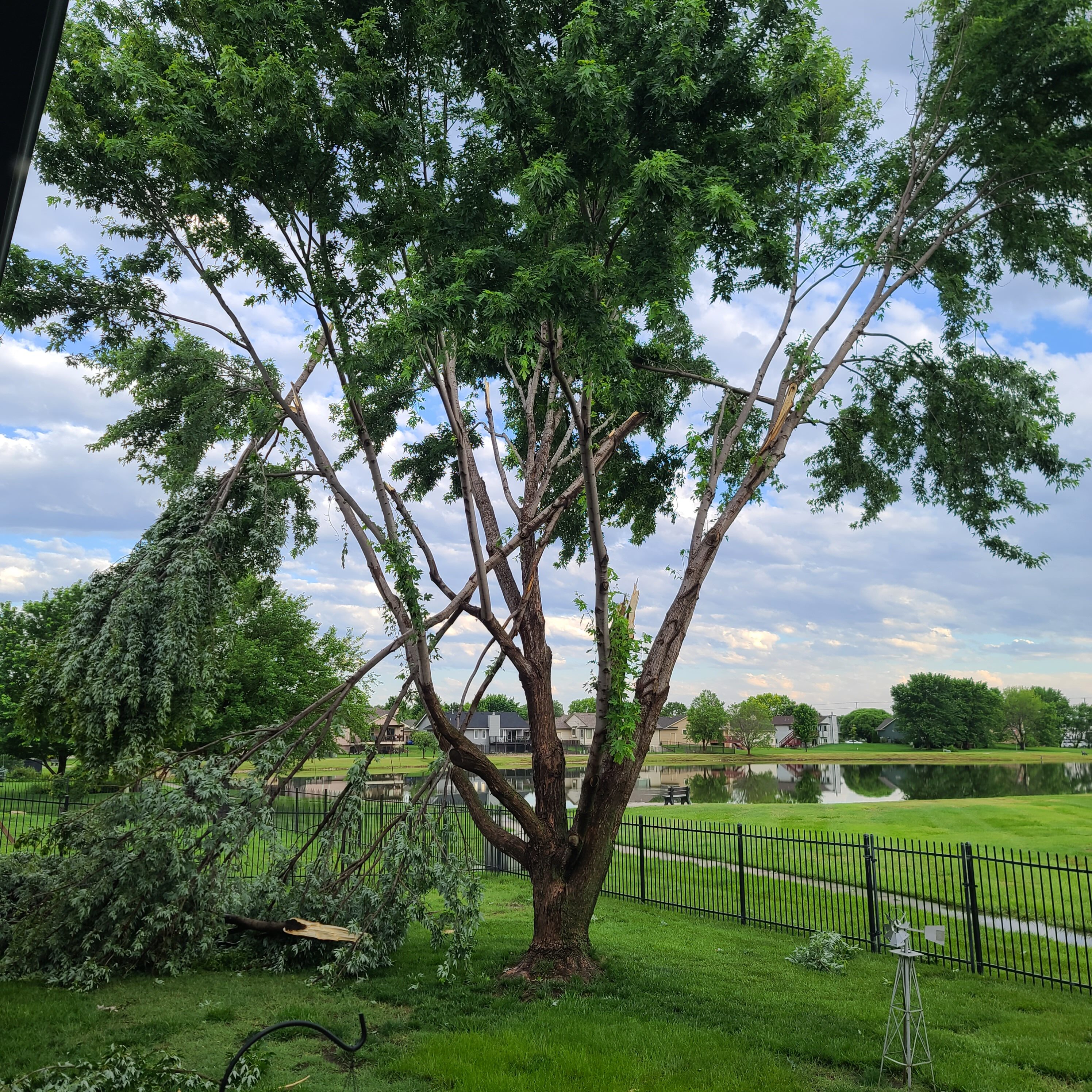
One time I was called to look at storm damage on a maple tree in a backyard. The tree had been badly damaged in a storm, with most of the major limbs broken. The homeowner asked why their neighbor’s maple, which was about the same age, height, species, and location, only had one or two broken limbs while theirs was nearly destroyed.
The answer was the pruning.
Why Lion-Tailing Weakens Trees
Their tree had been heavily lion-tailed by someone they believed was a professional tree service. They had been told that removing the interior branches would let the wind pass through the tree better. That sounds reasonable, but it is not how trees work.
The neighbor’s tree still had a fuller canopy. When the wind hit it, the force was spread through more leaves, branches, and the stronger lower parts of the tree. The damaged tree had been stripped out on the inside, leaving most of the weight and leaf surface at the ends of long limbs. That created more leverage, and when the storm hit, the limbs failed.
That homeowner paid once to have the tree pruned, then paid again to clean up the storm damage. Worse than that, the tree was permanently damaged.
That is why proper pruning matters. A cheaper tree trimming job is not a good deal if it weakens the tree, creates future hazards, or destroys a tree the homeowner was trying to care for.
If Pruning Wounds a Tree, Why Do Arborists Do It?
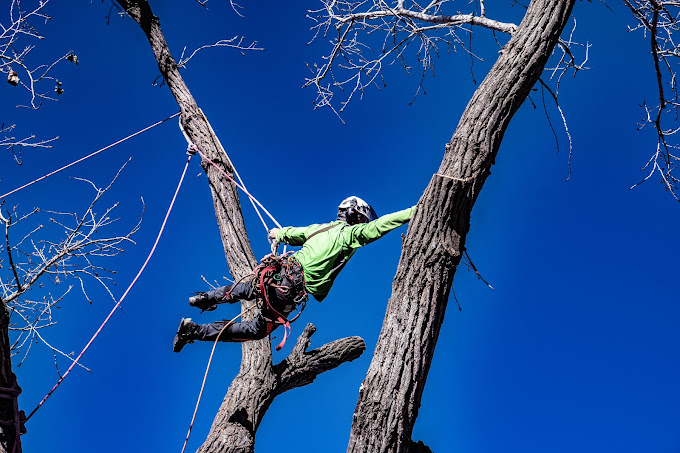
Because sometimes the benefit is worth the wound.
Every Cut Should Have a Purpose
Most people hire a tree service because they want to help their tree. The problem is that not every cut helps the tree, and some cuts can create bigger problems than the original issue.
This is where an arborist comes in. A good arborist does not just look at what can be cut. They look at what the property owner is trying to accomplish and how the tree is likely to respond. The goal may be reducing risk, improving appearance, providing clearance, removing deadwood, correcting a structural defect, or managing a disease problem.
Sometimes Leaving a Limb Is Better
Sometimes pruning is clearly beneficial. Other times the answer is less obvious.
For example, I often get requests to remove large limbs over houses. In some situations, that is absolutely the right recommendation. In other situations, removing the limb creates a large wound that may never properly close. Years later, that wound can develop decay and become a larger structural problem than the limb ever was.
That is why tree pruning should not be performed by a "yes man" with a chainsaw. The job of an arborist is to help the property owner make an informed decision by balancing the owner's objectives with the long-term health, structure, and risk of the tree.
If you are hiring someone to help your tree, make sure they actually understand trees.
How Do I Know If Someone Is Qualified to Prune My Tree?
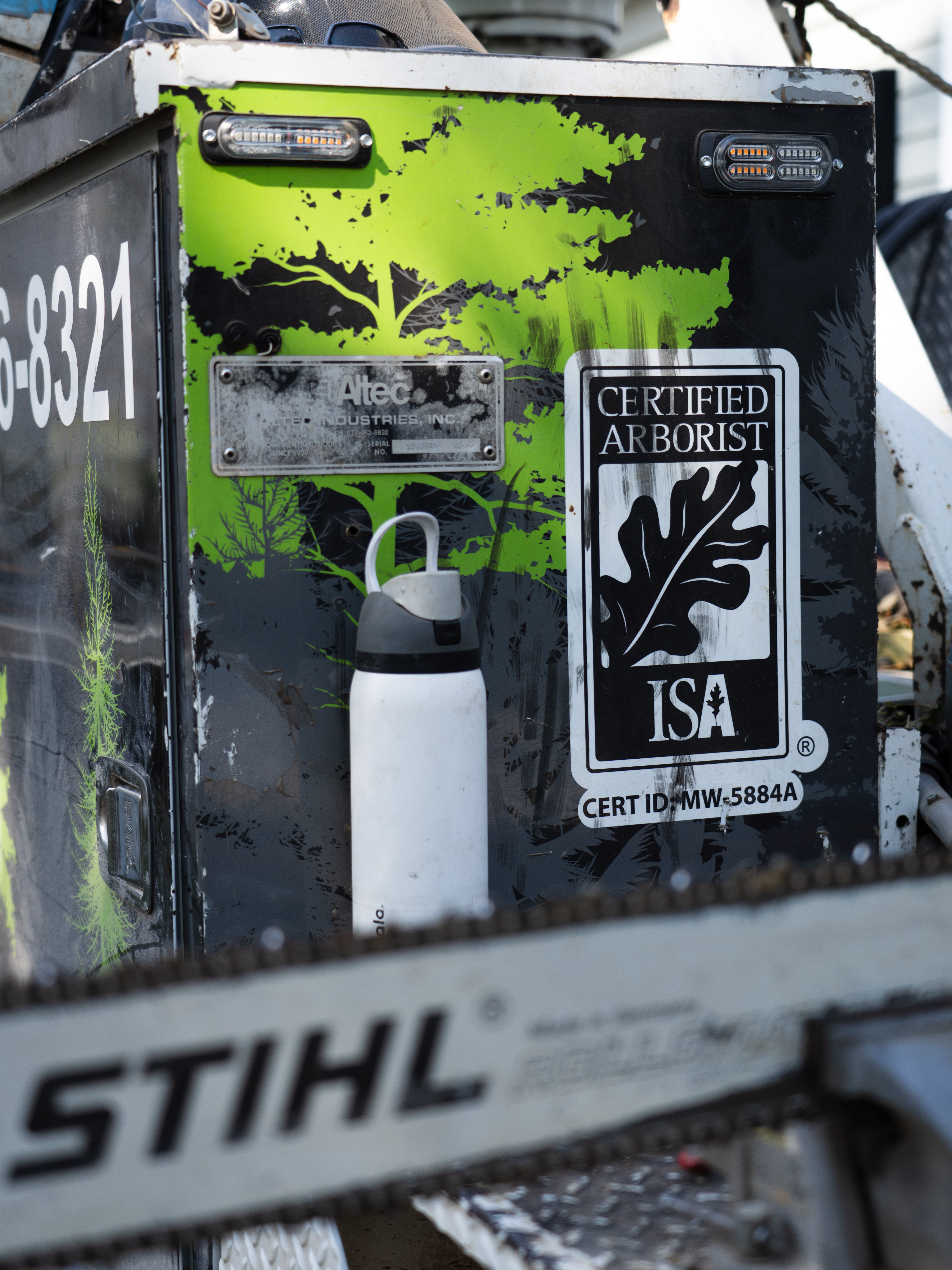
Anyone can call themselves an arborist. That does not mean they understand how trees respond to pruning.
As a Board Certified Master Arborist, I spent years gaining experience, studying arboriculture, passing examinations, and completing continuing education to earn and maintain my credentials. It can be frustrating to see companies advertise certifications they do not actually hold, which is one of the reasons I encourage homeowners to verify credentials for themselves rather than simply taking someone's word for it.
Verify the Certification
Look for ISA Certified Arborist logos, ask whether the person making the pruning recommendations is actually certified, and then verify the credential online. ISA requires the arborist's name and certification number to be displayed with the certification logo. If you see the logo without a name or certification number, ask who holds the credential and verify it for yourself. If someone claims to be certified, you should be able to find them in the certification database.
Credentials Are a Good Start
Kansas Certified Arborist and ISA Certified Arborist credentials are both good signs. They show the person has taken the time to learn trees beyond just cutting them. An ISA Certified Arborist usually reflects broader arboricultural knowledge, field experience, testing, and continuing education.
Credentials matter, but they are not the whole story. Experience, judgment, and supervision matter too. I would not want someone with only one or two years of experience making major pruning cuts on my trees unless they were working under someone more experienced.
Ask Who Makes the Pruning Decisions
A Board Certified Master Arborist is an advanced ISA credential that shows a higher level of dedication to arboriculture. It requires advanced knowledge, continuing education, and a long-term commitment to the craft.
When you hire a tree company, ask who is actually making the pruning decisions. A good company should be able to explain why the cut is being made, what the objective is, and how the tree is expected to respond.
You can verify certified arborists through the Kansas Arborists Association or the ISA Find an Arborist tool.
When Should Trees Be Trimmed in Wichita?
The best time to trim a tree depends on the species, the goal of the pruning, and the overall condition of the tree.
Light Pruning Can Be Done Year-Round
In the Wichita area, most trees can be lightly pruned throughout the year as long as large amounts of live foliage are not being removed. Dead branches, broken limbs, minor clearance issues, and small corrective cuts can often be handled safely during any season.
My general approach is that less is more. I would rather make many small, thoughtful cuts than one large cut that creates a wound the tree may struggle to close. Smaller pruning wounds are usually easier for a healthy tree to compartmentalize. Large wounds can create long-term decay issues, especially when they are made on mature trees.
Some Species Require Special Timing
There are times when season does matter. Oak trees are a good example. Wichita does not currently have the same oak wilt pressure seen in some other regions, but oak wilt is present in surrounding states. Because the disease can be spread by insects attracted to fresh wounds, it is generally better to avoid unnecessary oak pruning during the warmer months when those insects are active. When practical, fall and winter are better times for oak pruning.
Avoid Heavy Pruning During Stress
We also try to avoid major pruning during extreme heat, drought stress, or other periods when the tree is already struggling. Removing too much canopy during stressful weather can reduce the tree’s ability to produce energy and recover.
For larger structural pruning, late winter is often a good time. The tree is still dormant, but spring growth is close behind. As the tree enters the growing season, it has a better opportunity to begin compartmentalizing pruning wounds and replacing some of the foliage lost during pruning.
Do Not Remove Too Much Canopy
As a general rule, no more than one-third of a tree’s live canopy should be removed at one time. In most cases, I believe that number is too high. Most proper pruning should remove far less. Many jobs only require one to ten percent live canopy reduction, and healthy green branches should only be removed when there is a clear reason, such as safety, structure, clearance, storm damage, or a specific customer objective.
If a tree truly needs heavy pruning, it is often better to spread the work over multiple years. That gives the tree time to recover between pruning cycles and reduces the chance of causing unnecessary stress.
Schedule Professional Tree Trimming in Wichita, KS
If you are thinking about trimming a tree, the first step is making sure the work actually needs to be done. Wichita Tree Service can inspect the tree, explain what we recommend, and tell you what we would avoid cutting.
Our goal is not to remove as much as possible. Our goal is to make the right cuts for the tree, the property, and the long-term outcome.
Robert Phillips, MW-5884B, owner of Wichita Tree Service, is an ISA Board Certified Master Arborist.
Call Wichita Tree Service today at 316-616-8321 to schedule professional tree trimming or pruning in Wichita, KS and surrounding communities.
You can also view more of our tree trimming, pruning, removals, equipment, and jobsite photos on our Instagram and Facebook pages.